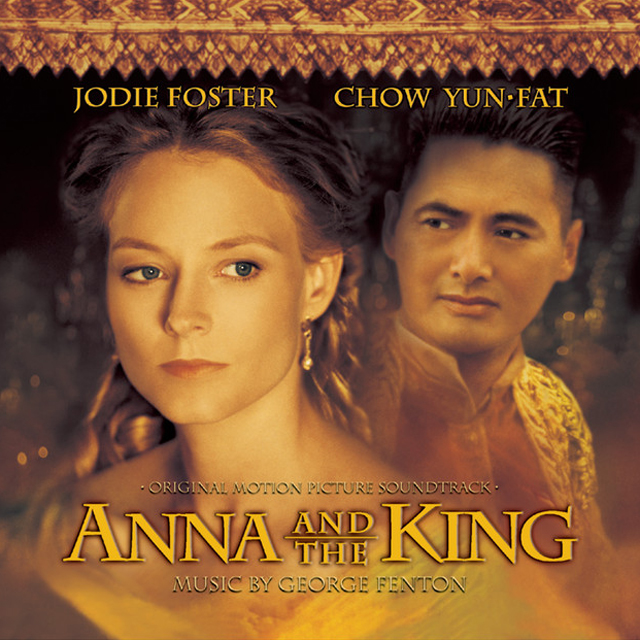
Neither critics nor audiences seemed to think much of Andy Tennant’s 1999 re-telling of Margaret Landon’s Anna and the King of Siam, with Jodie Foster and Chow Yun-Fat in the lead roles. I have to say I always had a soft spot for it: its deliberate throwback style to an earlier kind of filmmaking actually felt quite refreshing to me and on a technical level the film is beyond reproach thanks to Caleb Deschanel’s wide-open-vista style of cinematography highlighting the genuine beauty of Luciana Arrighi’s production design.
And the score… the score. I get the impression that when director Tennant started working with George Fenton, he essentially allowed the composer to write what he wanted (because it happened to be what Tennant wanted too) – no restrictions, no holding back, no avoiding emotion. One year earlier Fenton wrote one of his most satisfying scores for his first film with this director (Ever After) and then he went one better for Anna and the King, writing music of great scope and great sweep that makes, I think, for his finest work for Hollywood.

The score is densely packed with good themes and perhaps the most memorable is the love theme. We actually hear it for the first time on the album in a song, “How Can I Not Love You?” sung by Joy Enriquez, which is really lovely – but it’s in the orchestral arrangements within the body of the score where it really shines. The first of these comes up very early in the opening “Arrival at the Palace” where it gets a rousing rendition; perhaps the strongest arrangement comes much later, in the sweeping “Anna Returns”, but it’s also hard to resist the charms of the more intimate “Moonlit Beach”.
The epic opening piece of score also introduces us to two of the score’s other most notable features. First is the incorporation of ethnic elements into the score – this is something that Fenton did well (with various ethnicities) over the years – think of Gandhi, Cry Freedom, A Handful of Dust – and here we get the distinctively soothing presence of the erhu (performed exquisitely by Karen Han) along with some Chinese wind instruments and an array of exotic percussion. The composer often uses the erhu and violin in a sort of dance with each other and the effect is stunning. I know lots of people love it when film scores mix Asian elements into a traditional western symphonic setting – and these people will be head-over-heels for Anna and the King.
The other aspect – only fairly briefly heard in the opening piece, but becoming more prominent later – is the grand-scale action music. When I say grand I do mean grand – in some ways this hearkens back to the kind of epic film scoring we got in the so-called golden age. The score gets no more epic than in the stunning “The Execution”, beautifully melodic and really very moving; and there are various terrific action pieces – the thunderous “Rajah Attack”, the percussive and tragic “Betrayed”, perhaps best of all “The Bridge”.
Other pieces of note include the intricate, exquisite “Tuptim” (focusing on the secondary phrase of the love theme), a semi-comic theme which accompanies the more fish-out-of-water sequences for Anna (best heard in “Letter of the Week”) and the charming dance pieces “Anniversary Polka” and “I Am King, I Shall Lead”. In the latter, Fenton introduces a beautiful alternative theme for the relationship between the two main characters and then – quite brilliantly – towards the end of the score, he hearkens back to it, now with real melancholy, in the opening section of “I Have Danced With a King” – it develops into a stunning conclusion to the score.
It’s all stunning though really, an hour’s music of charm, elegance, grace and beauty that I’m surprised I haven’t worn out, I’ve listened to it so much. I distinctly remember at the time this came out – following so hot on the heels of Dangerous Beauty and Ever After – when I thought George Fenton had a chance to emerge as an unlikely torch-bearer for the kind of film music I had always really liked, as everything was changing so fundamentally around him. Sadly the films like these three didn’t really keep on coming – he kept doing very strong work on a huge range of films in the coming years, but it was to the small screen, and the wonderful world of David Attenborough, that he turned to really carry on this grand orchestral tradition in which he was so accomplished.
What a composer he was – he could do anything really, and just about everything he could do can be heard in Anna and the King. I think he was second only to the great John Barry in the ranking of British film composers and he left us with a tremendous body of work to enjoy for many years to come.

Reply