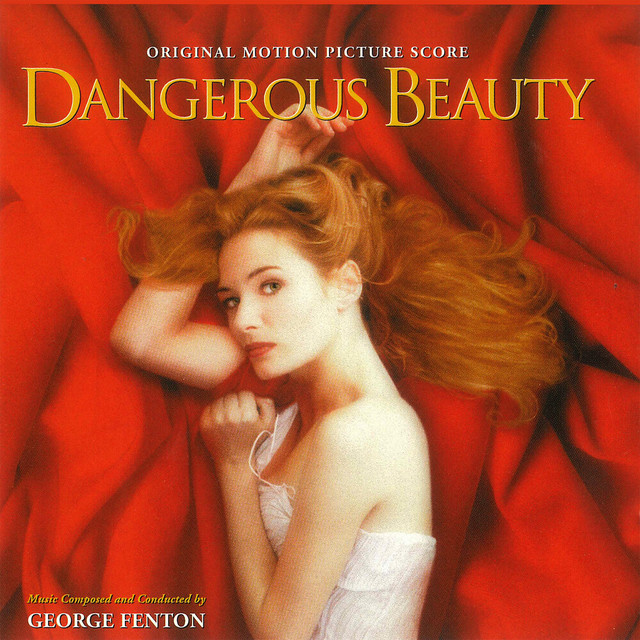
The second of only two films directed by prolific producer Marshall Herskovitz (the first being Jack the Bear), Dangerous Beauty came out in 1998 to little fanfare. Based on the true story of 16th century Venetian courtesan Veronica Franco, accused of witchcraft by the church, the film actually garnered very strong reviews but was barely released into cinemas (and so barely anyone saw it).
George Fenton was no stranger to romantic period drama but he often favoured a particularly English reserve to the topic. When the occasion demanded however, he could go big like the best of them – and for Dangerous Beauty, the occasion demanded. It was in fact the first of a trio of films released in the last couple of years of the 20th century that allowed the great composer to really flex his muscles and create grand romantic orchestral music in a way he hadn’t really had the opportunity to do before (and never would again) – see also his exception scores for Ever After and Anna and the King.

Dangerous Beauty is a score which is chock full of great, memorable, romantic themes and set pieces, the first of which appears immediately as guitar introduces the main theme in “Venice Proud and Pretty” where it takes on a delightfully fluid, light guise; not long afterwards we hear it in a different, considerably more romantic form in “The First Kiss”.
In between those two cues is the scherzo “Marco’s Homecoming”, a barnstorming piece of light-hearted adventure music for the full orchestra. A second big romantic theme is introduced in “I Cannot Marry You”, though it carries a tragic feel in that initial appearance (don’t worry, it soars away like gangbusters further down the line). The third of the score’s main themes is heard in comic guise in “Job Training / The Library” and Fenton has great fun with it in the cue.
I mentioned the score also features some great set pieces away from the themes – the festive flourish of “Veronica’s Ascent” is completely charming, and two of the best of the rest are “First Poetry Duel” and “Second Poetry Duel” (it is hard to find fault with a film which chronicles two separate poetry duels). The first begins deceptively innocuously before developing a sweep and swagger as it eventually hurtles to its majestic conclusion; the second has sweep and swagger from the outset before intriguingly turning dark as it nears the end.
And speaking of majestic conclusions, George Fenton wrote a few spectacular finales in his time and the way he brings all of his main themes together for “The Verdict / End Titles” is certainly one of them, one of the most satisfying (not to mention beautiful) pieces of music he ever wrote. We were blessed with so much great film music in the 1990s and Fenton wrote his share of it – Dangerous Beauty is one of the very best, such an effortlessly fast-moving and lush romantic score which I could never tire of listening to.
Reply