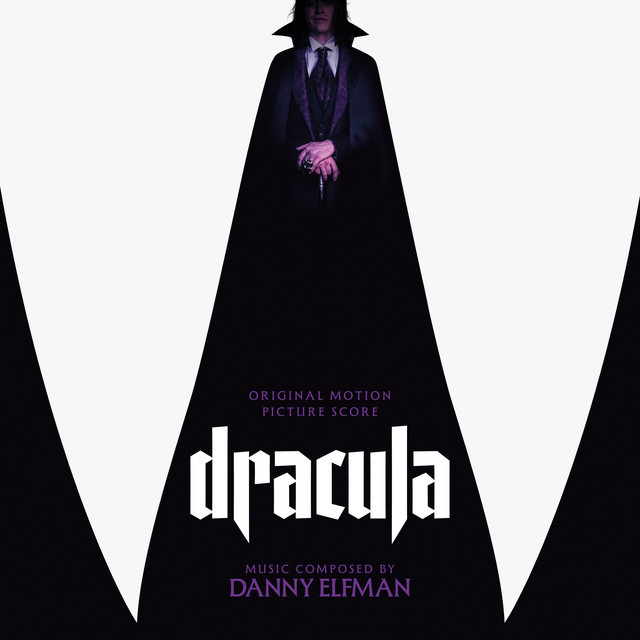
Luc Besson’s Dracula hasn’t seen much of a release anywhere yet outside of his native France, so most of us won’t have had a chance to see it. Reviews suggest it is essentially an homage to Francis Ford Coppola’s 1992 take on the story above all else, with many questioning what the point is. Given there have been approximately four billion cinematic takes on the tale, it probably stands to reason that two of them are similar to each other.
With the veteran director having been the subject of various sexual assault allegations in recent years (none proven), he perhaps wisely sought the musical services of a composer with a squeaky-clean record in that regard. It is a bit surprising that Danny Elfman – with his reputation for favouring the macabre, and his love of classic monster stories – has never scored a Dracula movie before; reportedly he has been very keen to do so for a long time.

There have been many really good Dracula film scores over the decades and lots of different people will have different favourites – but perhaps these days there may be a consensus around Wojciech Kilar’s exquisite score for Coppola’s version. Given this film’s apparent primary inspiration – and given that Elfman has previously written a score, The Wolfman, which seemed to draw considerable inspiration from Kilar’s classic – it is certainly no surprise that tonally there are various moments in this score where Kilar’s seems to loom large.
Elfman’s an incredibly distinctive composer himself though so don’t worry about this just being an homage. The main theme, introduced in the opening cue “Music Box”, is one that long-time fans will recognise not just from Corpse Bride – there have been variants on it in other Elfman scores over the years (not to mention Christopher Young’s The Piper – which conceivably could have used it in the temp-track, though it may have been a coincidence – and, perhaps most bizarrely, Alexandre Desplat’s La Fille du Puisatier, which surely must be a coincidence).
There are many variants on the theme – that initial music box version gets some trademark Elfman choral accompaniment; there’s a gorgeously melancholy take on it in “A Very Sad Story”, with beautiful solo voice accompanying; a big orchestral version for the end credits; and many more. It certainly fulfils the brief to be a classic romantically gothic theme.
The Kilar influence is revealed as early as the second cue, “Blessings”, and revisited several times later, perhaps most notably in the grand “Neverending Death”. There’s no direct lift going on here – it’s clearly homage, not plagiarism – and it’s handled very well, with Elfman frequently inserting his own theme in counterpoint to the Kilar tribute.
There’s a lot of strong music here, a lot of distinctive music too, so I would hesitate to use the word “tentative” – but it does feel at times that Elfman doesn’t quite goes as all-out as may have been expected. Don’t get me wrong, his touches are everywhere, little musical signatures that we all know from his four decades of writing film music – but with a small number of exceptions (the particularly macabre action track “A Bloody Meal” perhaps the most obvious), nearly every time the score seems to be about to explode, he pulls back to some degree.
This feels like one of those scores that may not have attracted much attention twenty years ago, but with standards having dropped elsewhere, it feels more noteworthy today. I’ll be honest and say I can’t really remember the last time a Danny Elfman album was as flat-out entertaining as this – the gothic romance and sweeping drama are so far up his street, he could hardly fail to deliver the goods. At 66 minutes the album feels a bit on the repetitive side, but otherwise it’s an easy recommendation.
Leave a Reply