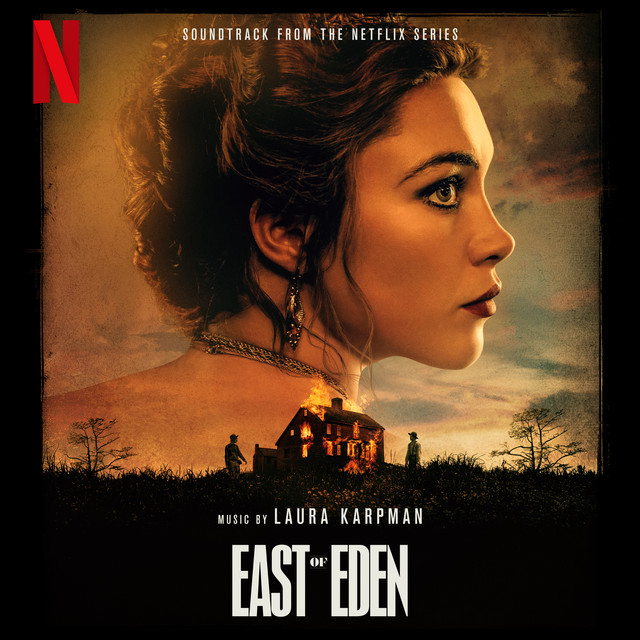
John Steinbeck’s masterpiece East of Eden has been famously adapted a couple of times before – but Elia Kazan’s 1955 film only covered its final part, and the very popular 1981 miniseries came out at a time when the full range of the novel’s dark sides couldn’t be explicitly drawn out on network television. So there’s certainly a place for a new adaptation and I think Zoe Kazan’s (there’s a certain symmetry since she is Elia’s granddaughter) 2026 version for Netflix is really very fine, drawing on fine performances all round as it tells the saga of the Trask family in between the US Civil War and the First World War, full of Steinbeck’s Cain and Abel allegory.
The previous filmed versions both feature acclaimed music (by Leonard Rosenman and Lee Holdridge, respectively) and I think Laura Karpman’s score for the new one can easily sit alongside them both. It’s a very different piece of work, reflecting the darkness and to some extent depravity that runs throughout the story, but when you look hard enough, there is (almost) always some chink of light or other peeking through and when she occasionally brings moments of levity they carry real weight.

This is illustrated perfectly in the trio of cues that open the album – we begin with the ominous “Snake in the Grass”, before “East of Eden” presents the warm, pastoral beauty of the main theme; then there is a complex mix of emotions in “Brothers”, with Karpman managing to convey everything from familial warmth to bitter rivalry to portent of tragedy to come in the space of three and a half minutes.
The bulk of the score is written for string orchestra and the composer gets such an impressive range of sounds from her ensemble – listen to “Fire”, where the percussive horror of the struck strings contrasts so fiercely with the bucolic beauty of the fiddle solo. Again – this clash between two contrasts is done so well – and anyone familiar with the story will realise immediately just how clever it is, given the themes explored.
Karpman doesn’t bring the same array of themes with her that Holdridge did for his version, but there are some very strong ones – Adam Trask’s, heard best in “Adam Comes Home”, is (as most everything else in the score) at times profoundly sad, at others strident and decent; and there’s a beautiful theme for the more outwardly idyllic moments of family life earlier in the story, such as in “Salinas”, the score’s largest concession to the classic sound of Americana which perhaps people may have expected the score to be – but even here there is a certain pity laying just under the beautiful surface, fully exposed in the cue’s dissonant conclusion.
Hoon Lee’s performance as Adam’s Chinese-American manservant Lee is a remarkable one (he deserves awards recognition) and Karpman’s theme for the character (simply “Lee”) is full of depth, with hints at his Chinese origins kept fairly subtle as she interweaves them into the distinctive style of the rest of the score. The second generation of Trask brothers get a simple representation of childhood innocence in the lullaby-like “Caleb and Aron” but quite openly battling with that feeling is the haunted sadness of their father, reflected by much darker textures.
I note there has been a somewhat muted response to Karpman’s music – by mirroring the very dark nature of much of the story, perhaps people have sensed a certain emotional detachment – I have to say that my reaction is the polar opposite of this, finding the sheer depth of emotion which permeates it all to be really quite exquisite. I think it’s probably the finest music she’s ever written and it’s one of the deepest, richest scores of the year so far. Don’t go into it expecting a Coplandesque slice of warm Americana because (as I’ve hopefully made clear) it most certainly isn’t that, but as I noted at the start – I think if anything that makes those moments of levity all the more effective when they do come.
Reply