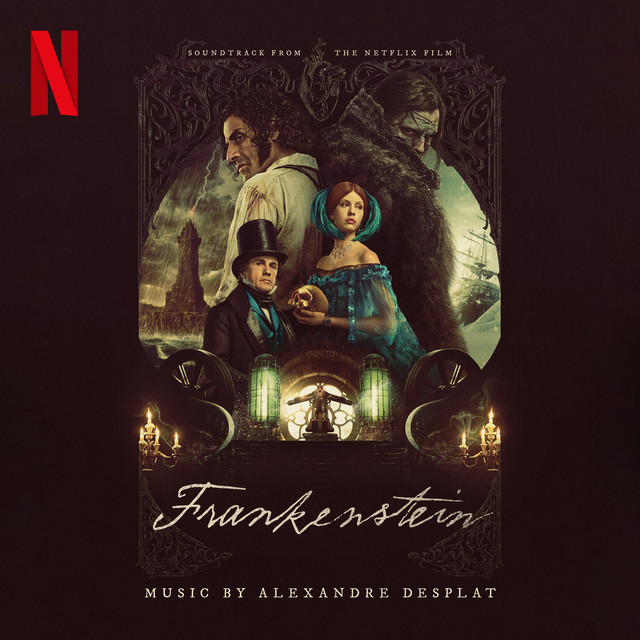
As in The Shape of Water and Pinocchio, Guillermo del Toro’s Frankenstein essentially ruminates on “what if the monster is good and the human is bad?” with the director’s answer being fairly clear from the outset. It’s a handsome, lavishly-staged film which has proved quite polarising it would seem: I certainly enjoyed the audio-visual experience, even if I found it somewhat overlong and Oscar Isaac’s performance as Victor Frankenstein surprisingly flat.
There’s certainly no shortage of cinematic adaptations of Mary Shelley’s classic novel; one of the things that sets this one apart from most of the better-known ones is its music, which steers very deliberately away from the expected “gothic horror” style and focuses much more on relationships and humanity (no prizes for guessing whose humanity ends up being much of its focus, layering on del Toro’s core message very thick).

When viewed through that lens, it’s easy to see why Alexandre Desplat is the director’s composer-of-choice for his “monsters” trilogy. Quite apart from the fact that he is obviously one of the finest film composers of his day, he is able to bring such an elegance and a grace to the way he explores feelings and relationships and he does this with music that is so precise and generally calm – every single little texture, every gentle movement is choreographed so carefully that when a harmony resolves itself in an unexpected way or a little phrase that we’ve heard several times do one thing suddenly changes direction and does something else, it has an impact – perhaps subliminally a lot of the time, but it does.
In the early parts of the score, Desplat explores his theme for Victor in a succession of cues: in the opening “Frankenstein” it’s slightly tentative, with a clear dark undercurrent, then in “Explosion” it is framed against evocative winds, taking on a feel almost like something lurking in a forest, before in “Victor’s Tale” as the melody is taken up by the piano it has a real warmth to it for the first time. This demonstration of the composer’s technique is all contained within the album’s opening six minutes.
A secondary theme, heard much less through the score and initially representing Victor’s relationship with his mother, is unveiled for the first time in “Burning Angel” and is perhaps the most appealing theme in the score. It is full of anguish and serves to underscore some of Victor’s motivation. In this initial appearance it also highlights one of this score’s key features, the exquisite violin solos played magnificently by Eldbjørg Hemsing.
Another major theme is for the creature itself. While for obvious reasons it is not heard much during the early parts of the score, Desplat does reveal it during “Lecture” as Victor publicly reveals his attempts to inject life into the dead for the first time. The composer gets real mileage from the theme as he presents it in different ways through the score, managing to use it to present quite distinctively different emotional feelings at different times – at times there is almost a lullaby-like quality to it, clearly conveying a sort of childish innocence – at others it takes on a feverish rage, anger sipping from it.
In “Elizabeth” we get what may be the most prototypical Desplat theme in the score, a beautiful duet for piano and violin the highlight after some gentle vocal accompaniment at the outset – he paints the character with an upper-class, almost opulent hue which could come straight out of The Girl with the Pearl Earring or The Painted Veil. It’s ravishing, gorgeous music. There’s also a pair of original waltzes (it wouldn’t be a Desplat score without them!) serving as more romantic material, unabashed and expansive – “Victor in Love” and “Victor & Elizabeth” (which actually appear as consecutive cues).
In “The Castle” Desplat makes his first move to create more of that gothic sound that is more typical of this genre, but he does it very much in his own way, with a violin fantasy on Victor’s theme playing out against the orchestra and choir in the cue’s first part and then that secondary theme dominating the second half.
We get another waltz as Victor begins the process of bringing his creature to life in “Body Building” – the composer here in fully ironic mode, giving the most beautiful dancing accompaniment to the sequence (it actually sounds quite a lot like music by another of this director’s collaborators, Danny Elfman, in its grandeur and arrangement, particularly the use of choir). But then in the cue’s final section, it takes an abrupt about-turn and Desplat introduces his trademark electronic bass which rumbles underneath grand but simple phrases from orchestra and choir, a great example of the kind of juxtaposition he uses in his music which I highlighted earlier.
For the creation itself we get (not surprisingly) one of the score’s grandest cues, “The Tower” – it plays out like a kind of orchestral maelstrom, an increasingly-urgent little phrase repeating on top of it all and pulling it along. The composer (quite delightfully) introduces a nod to the Franz Waxman version of all this with a striking horn phrase that leads into a sequence for organ, a doom-laden blast from the trumpets and then a driving, rhythmic sequence of grand power. But then listen to the elegiac strings that appear mid-way through – a clear signal that this version of the creation is not like (for example) the one that Patrick Doyle scored which enabled him to conjure up one of his own most famous creations. With the dour, rumbling sequence which closes out Desplat’s version running for quite some time, I doubt this cue will end up on nearly as many playlists as Doyle’s equivalent, though I have to say it fits this film like a glove.
In typical style, the composer follows up all the hi-jinks with the exquisitely beautiful “Awakening”, Victor’s theme getting one of its best versions, solo violin this time. And then we hear that childlike version of the creature’s theme in “Everything is New”, ironically this cue being the one that so clearly signals awakening – first warm and sunny before a considerably more tentative, nervous feeling takes over and finally an undisguised sinister air. It’s masterful musical storytelling. His theme takes centre stage in the glorious “Floating Leaf”, this one warm and sympathetic and mesmerisingly beautiful.
As should be pretty blindingly obvious by now, this is not a score with much of what you might call “action” music. There are times though when the composer does give his music a really propulsive, driving feel – he turns Victor’s theme into a long-lined theme in “Fire”, which features more of those expressions of explosive grandeur (albeit with a dire undercurrent) that we heard earlier in “The Tower”. It’s a great piece.
After that cue we reach a real turning point in the film and score. In “Creature’s Tale”, suddenly there is a rage building – that second type of expression of his theme as he becomes the focus. “Hunters” opens with more pseudo-action with a set of impressionistic violin runs before calming to sombre reflection and then we hear the score’s final major theme in “Family Life” as the creature is befriended by a blind man. There’s such a sense of calmness to the piece, fluttering winds and shimmering strings, and the theme itself is one of pastoral beauty. It’s remarkable how the composer turns it into a theme of great sadness just two cues later in “A Friend”.
“Recollection” and “Return to the Tower” play out as a kind of lament, reflective but tentative prods of the creature’s theme highlighting the former, but the latter then takes a turn to darkness as it plays out. The darker side persists as the score draws to its close – in “Confrontation” ominous timpani rumble away clearly signalling menace (though the cue does also feature one of the surprisingly rare appearances of Elizabeth’s lovely theme) and then shortly thereafter we get the first pure action cue of the whole score in “Don’t Delay” as a frantic feel takes hold which continues through the more suspenseful “Tent & Dynamite”.
The score then draws to a close with two very contemplative pieces – the emotional “Forgiveness” offers some sort of catharsis and then “Eternity”, while not sweeping away as its title may imply, is a satisfying conclusion. In each of these pieces the composer plays the two central characters’ themes off against each other very cleverly and so naturally, as if they were constructed with this purpose in mind – as, I’m sure, they were.
I have to say that I think Alexandre Desplat executed Guillermo del Toro’s vision for Frankenstein somewhat more successfully than del Toro did himself. It is a lavish, multi-layered score but one with a singular purpose. You should not expect it to sound like Godzilla with a bit more emotion thrown in, because it is a million miles from that sound – it is very much an “interior” score based on feelings and relationships, so think of it more as being like The Painted Veil with an occasional gothic flair added. I’m not convinced it is especially well-served by having such a long album (an hour and 44 minutes) but on the flip side of that, everything included does have something to add to the musical storytelling which is especially vivid throughout. It’s clearly one of the year’s most elegant and rich film scores.
Leave a Reply