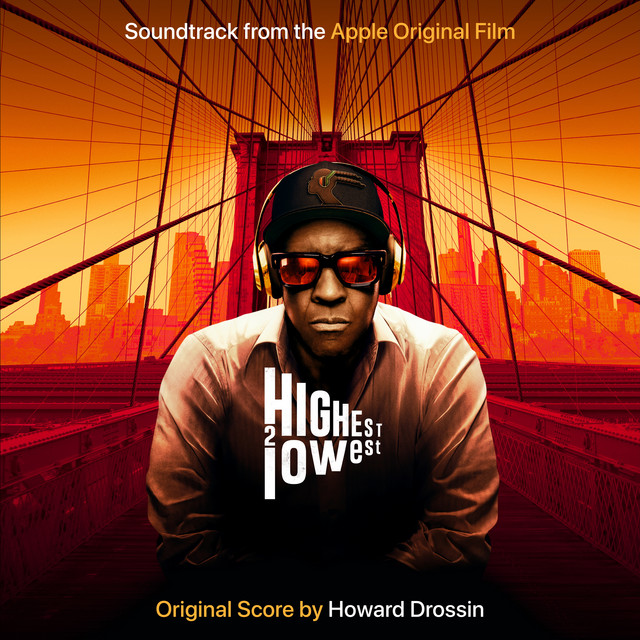
A thought-provoking thriller, Spike Lee’s Highest 2 Lowest is a loose remake of Akira Kurosawa’s High and Low. Denzel Washington plays a music mogul who believes his son has been kidnapped and is prepared to pay the hefty ransom, but when it turns out it is actually his driver’s son who has been kidnapped has to decide whether he’s still willing to hand over the cash.
It is one of the most interestingly-spotted films I’ve watched in quite some time. I’m always clear (even if some people find the whole notion ridiculous) that when I write on this website, I write about soundtrack albums and not about how music is used in films, but I’ll make a brief exception in this case because the score is used in such a profoundly different way from what we’ve become used to over the last 25 years or so.

The first surprising thing about it is that it’s not by Lee’s usual composer Terence Blanchard but instead by Howard Drossin. Drossin has been part of the music team, often providing orchestrations, for quite a few of Lee’s films over the years – interestingly, regardless of whether Blanchard is the composer or not – but this marks his first above-the-line credit for the director.
It is elegant, traditional orchestral film music in the romantic classical idiom. This is not the sort of thing you’d expect to hear in a gritty modern action thriller – well, perhaps it is when the director is Spike Lee, whose films don’t tend to feature music the way others do. What is different about it is that this elegant music appears when you don’t necessarily expect it to – searing beauty over a seemingly-innocuous dialogue scene perhaps, balletic dance over action. I’ve noticed a few reviews of the film comment negatively on it but I found it very refreshing.
The album opens with the elegiac “And Now We Shall Begin”, strings being strained for every last drop of emotion. The main themes start to appear after this – the lush, warm americana of “Coach Foxy”, reprised in “All Money Ain’t Good Money”, then the romantic “Loving Partners”.
A real fillip for people like me (by which I almost certainly also mean people like you, if you’re reading this – don’t take offence at being compared with me) comes in the first action track, “Somebody Got Trey”, which absolutely sounds like it could come from a 1990s Jerry Goldsmith action thriller score – Air Force One or US Marshals etc – the martial percussion, the simple motif from which everything springs – it comes so far out of left field (who thought we would ever hear music like that in a film score again – we haven’t done, for so long) – it’s handled beautifully.
There’s a little sequence of cues featuring that action style which culminates in “Trey is Found”, a really interesting piece which travels from the action through to (again somewhat Goldsmithian) orchestral apotheosis which then turns rather dark and tense – and finally turns to light jazz. If it sounds like an unlikely mix, it is, but somehow it works.
Interestingly, from that point, the jazz begins to become a feature of the score, featuring Scottish jazz pianist Fergus McCreadie and his trio. He’s also a composer and on the streaming services, these pieces are credited exclusively to McCreadie (and there’s even a whole album – separate to the main score album – devoted to his work on the score) though I assume Drossin actually wrote these as well, so integrated are they into the score’s fascinating fabric.
Before we get there, the album goes through a series of impressive dramatic cues, from the strained “Paul Begs” through to the very touching piano piece “Father 2 Son”, a wonderful variant on the score’s main theme. The jazz starts in earnest in the dazzling “Stony Gate” and “We Got This”, the piano seemingly dancing around – so light and airy. The longer it goes on, the greater the celtic influence becomes.
After a further string of very warm orchestral pieces, the highlight being the touching “Questioning Kyle”, we get to another 90s-style action piece “These Mean Streets” and then perhaps the score’s most extraordinary cue, “The Chase”, with that jazz theme returning in tandem with the orchestra for what must be one of the most unlikely action tracks we’ve heard in quite some time.
Regardless of how you may view its function in the film (I’ve already said I was impressed), on album this really is a very impressive piece of work. It is full of class from start to finish, features a couple of very strong, memorable themes and is very beautiful throughout. Highly recommended.

Leave a Reply