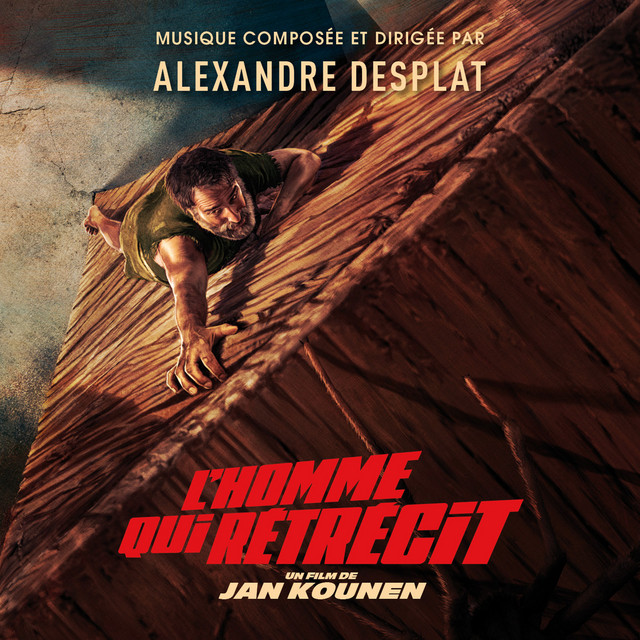
The third film adaptation of Richard Matheson’s classic 1956 science fiction novel The Shinking Man, L’homme qui rétrécit stars Jean Dujardin in the title role and is directed by Jan Kounen. So far only released in a small number of countries outside its native France, it’s received fairly middling critical notices but is of course of relevance to readers of this website thanks to its surprisingly little-publicised score by today’s foremost French film composer Alexandre Desplat, who somehow found time for it in between his significant Hollywood blockbusters in 2025.
His score is quintessentially French in a way that is hard to explain. No it doesn’t feature lots of accordions or quote “La Marseillaise” but there is something in its quirky nature which is so inherently Gallic. It is also absolutely, unmistakably, quintessentially Alexandre Desplat – one of the most distinctive film composers of his generation.

The album opens with the score’s main theme. It’s surprisingly low-key and subdued actually – subtle harmonic motion ebbs and flows, an interesting sound from some electronic and acoustic effects actually recalls some of the science fiction classics of the 1950s, but in an extremely understated way. I think Desplat is wonderful but am aware that he is quite divisive amongst the broader film music fan community and those who haven’t been won over previously certainly won’t be won over here – don’t come in expecting big sci-fi grandstanding or great big themes because there is absolutely none of it.
I actually prefer the score’s second theme, first heard in “Mia”, which has a real mysterioso to it. And it’s that feeling that pervades much of the score – echoing the story, it starts off with tentative confusion, all sorts of different little flute, piano and guitar solos weaving in and out. In “La maison de poupée” this turns into a kind of comical whimsy – so French, and the sort of thing you could imagine coming from one of the composer’s Wes Anderson scores.
I have to say that for all its undoubted quality, there is a sense across the first 15 minutes or so of the album that it is meandering along somewhat, but something of a turning point is reached in the more dynamic “Plus petit” where a more forcible sense of intrigue is heard for the first time. And while the composer does keep his touch pretty subtle for the most part, a few cues certainly have more of a sense of drive to them,
The first real tension arrives in “Le chat” – that trademark electronic bass pulse that Desplat loves so much provides some of this behind some pretty cacophonous orchestral hijinks. For the vast majority of the album though, this is very much an exception – far from sounding like a science fiction adventure score, it is largely much more like a psychological thriller score with some light-hearted elements thrown in from time to time, and it’s important to go in with that as your expectation else you might be a little thrown, as I was initially.
There are a few exceptions. “La tapette” is a delightful piece of action music, heavy on percussion and with an interesting atmosphere coming from an electric guitar; “Soûl” is a much darker piece, low-end strings and brass combining with percussion hits as Desplat really ratchets up the tension for a while, before returning to that wonderful “Mia” theme; and in the subsequent “L’araignée” things really get interesting, the composer finally unleashing a piece of all-out action. Based on a great theme, it’s a thrilling piece. “Mosquito” too is a great piece of action music, the high violins contrasting so well with the bass-laden undergrowth. In “Abandon et espoir” there is quite an emotional drive to the piece going with a dramatic urgency – it’s one of the strongest cues.
I suspect that some will be disappointed that the score doesn’t have a bit more of that oomph running throughout rather than it being largely saved for the latter stages and while it is certainly a surprisingly subtle piece of work given the subject matter, I find there is something strangely compelling about the album. It is very much an Alexandre Desplat score, one infused with his trademark elegance and precision, and it shouldn’t get forgotten in between Jurassic World and Frankenstein because it certainly has something to offer the composer’s fans.
Leave a Reply