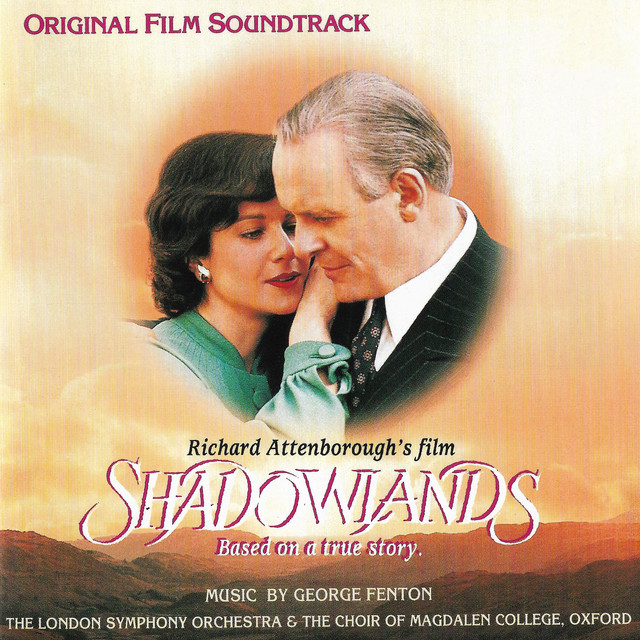
Adapted by William Nicholson from his own acclaimed play, Richard Attenborough’s very well-regarded 1993 film Shadowlands tells of the relationship between C.S. Lewis and Joy Gresham in the 1950s. Anthony Hopkins and Debra Winger are perfect as the odd couple – he, very reserved and very English; she, very brash and very American.
The film marked the third collaboration between Attenborough and his most regular composer George Fenton. For the first two, Gandhi and Cry Freedom, Fenton worked with Ravi Shankar and Jonas Gwangwa respectively to bring a sense of authenticity to their Indian and South African settings; this time round the assignment required no collaborator, with the composer striving for a uniquely English sound to the score, reminiscent both of the church music tradition and also the very distinctive sound of great English composers like Elgar.

These two sides to the score are revealed in turn in the first two tracks. The score opens with the liturgical “Veni Sancte Spiritus”, Fenton setting the Latin text to a beautiful melody sung by boys’ choir with boy soprano soloist, church organ accompanying. It is reverent and distinguished and sounds like it could be a genuine centuries-old hymn (it isn’t) – it’s wonderful.
Then comes the score’s main theme, introduced in “The Golden Valley”. Far from a sweeping love theme, it reflects Lewis’s reserve while also clearly conveying the blossoming relationship between he and Gresham. The Elgar influence is plain to hear – absolutely no pomp and circumstance, but an elegant and refined sense of patriotism sitting atop the warmth that is clearly there at the piece’s heart, but doesn’t necessarily want to expose itself to allegations of vulgarity by being too overt. It is one of the composer’s most perfect creations.
As the score progresses, the romance does come more and more to the surface – in “The Lake”, the melody of the opening choral piece is now heard for glorious pastoral horns, full of the charm of rolling hills and birdsong on a summer’s day in the Cotswolds. The sheer elegance of “The Drive to the Hotel” is awash with such gentle beauty it is almost too much to bear.
What Fenton taps into in this score is an almost perfect musical expression of what is, I think, the unique nature of English patriotism. While in more recent times it has been darkened by more sinister tendencies, certainly when I was growing up – and I imagine even more so in the 1950s when this film was set – there was a sense that waving flags and singing nationalistic anthems was uncouth – that feelings of nationalistic pride didn’t need to be expressed outwardly because inwardly everyone had the arrogant belief that of course the English were superior to everyone else – in those dying days of empire, not quite realising yet that they no longer occupied the position of power that had been the case for so long. And it is this precise feeling that Fenton manages to capture so well in his exquisite music. He manages to do not just that but also craft it in a way that offers perfect dramatic architecture mirroring Lewis’s feelings for Gresham – the inquisitive beginning, then falling in love, then dealing with the worst tragedy – and all in the most beautifully understated, stoic way – outwardly unchanging, inwardly in turmoil of all sorts.
This “unchanging, yet forever changed” feel is brilliantly displayed by the bookending nature of the two themes which again appear in quick succession at the end of the score, just as they did at the start. The choirboy reappears for the first time since the opening in “As a Boy and As a Man”, providing wordless accompaniment this time to a rare moment of orchestral swell – and then Fenton treats us to a second original hymn, “Sanctis Solemniis”, given a stunning performance by the Choir of Magdelene College, Oxford (where Lewis taught).
Things are brought to an end in the cathartic end title piece, the main theme given its most glorious arrangement – the meandering melody which rises and falls so subtly, the sense of feeling so strong yet so unwilling to appear to be that – it is a stunning conclusion to a score which is nothing short of a masterpiece.
Leave a Reply