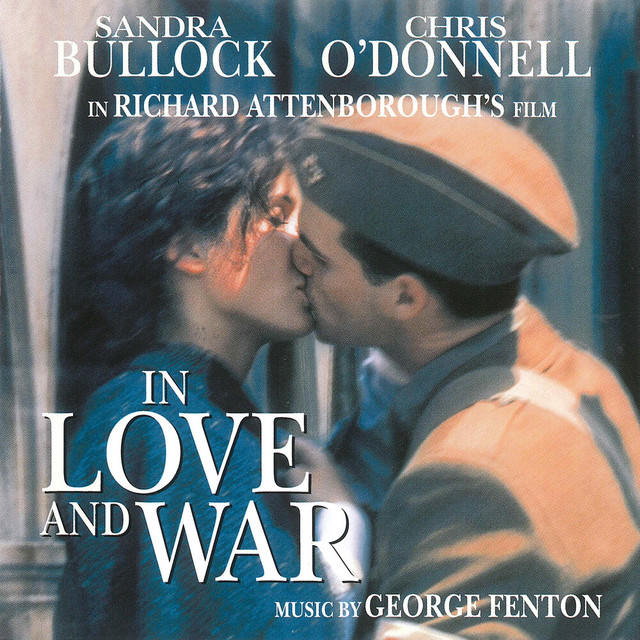
Richard Attenborough’s 1996 film In Love and War tells a heavily fictionalised version of Ernest Hemingway’s experience of the First World War, where he was badly wounded and fell in love with the nurse who took care of him (a relationship which would go on to inspire A Farewell to Arms). Chris O’Donnell and Sandra Bullock star but the film received a critical mauling and Attenborough would never really find success as a director again.
Most of the films from the second half of the director’s career were scored by George Fenton, who made his name with his work on Gandhi. His staggeringly beautiful music for this one focuses very much more on the love than the war as he presents a parade of romantic themes, each of which is delicious and when taken together make for a really exceptionally pretty album.

The pick of them is heard briefly in the first half of the opening “Leaving for the Front” and I will return to it later; in the second half, we do get a musical acknowledgement of the film’s setting as elegiac strings suddenly kick in and an epic sweep develops. There’s a great patriotic feel to the solo trumpet of “Rescuing Roberto” before tragedy strikes in “The Bullet” – but in Fenton’s hands the tragedy has such a reflective beauty to it, the piece is irresistible.
More light-hearted is “The Drive with Domenico”, a piece which has a similar spirit to those breezy European scores that won Oscars around this time like Il Postino and Life is Beautiful. “Small Talk” plays out like a gentle breeze on a summer’s day, a duet between piano and oboe floating around so wistfully. A delicate waltz theme is heard a few times – my favourite version is the particularly elegant one in “The Trip to Venice”.
All the gorgeous romantic material is occasionally punctuated by more source-like militaristic music and even more occasionally by more serious dramatic fare (most notably in “POWs”) and it makes for a great album but the absolute highlight is that magnificent main theme. It gets a glorious arrangement in “Agnes’s Theme” but there’s no doubting the real coup de grace, which is the astoundingly rousing version Fenton saves for the end credits.
It starts innocuously enough, as another reprise of a lovely theme, then after about 45 seconds the orchestra swells for the first time – it’s big – and then it just keeps getting bigger and bigger. It is a piece of epic romance in the grand Hollywood tradition, an incredible piece of music (one of Fenton’s very best) – and even more incredible is that I’ve been listening to this album for thirty years and don’t think I have ever heard anyone else even mention it. Don’t miss out: there’s one extraordinary piece of music here which overshadows all else, but that shouldn’t detract from the fact that the score as a whole is a real delight.
Leave a Reply