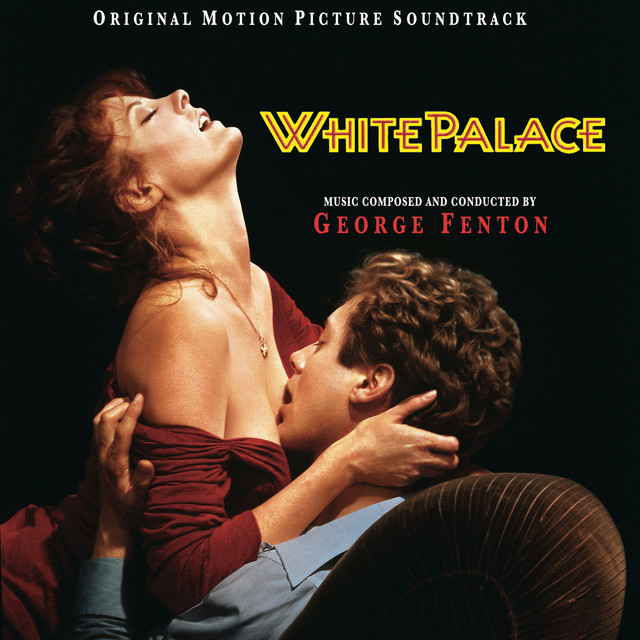
A 1990 film about an unlikely romance across both a class and age divide, White Palace stars Susan Sarandon as a waitress in a burger joint and James Spader as an upper-class widower, who end up falling for each other. The film seems to be largely forgotten today but attracted decent enough reviews on its release.
At some point in the 1990s I started watching the film on tv and was struck by its incredible opening title music, by George Fenton, and it has lived in my mind ever since. An exceptionally pretty melody is heard for piano with minimal accompaniment before strings enter to provide further elegance. To this day I don’t know if it is a pastiche by Fenton or a direct quote of something (CoPilot tells me that it sounds like Mahler – it doesn’t sound like Mahler).

Then at 1’46” something sublime happens – a sax enters to take up the melody, a subtle drum kit accompanies – before that makes way for the piano again. In three minutes of music, Fenton tells the story of the film – the exquisitely elegant classical sound signifying Spader’s taste for the finer things in life, the more grounded realism of the 20th century music that appears – for now at least – in perfect harmony with it. I’ve been obsessed with the piece for 30+ years and always sit there completely rapt with attention whenever I listen to it.
In truth, the rest of the score is more routine – it has to be. We hear fragments of that opening piece’s melody used in all sorts of guises and the composer uses them to launch off in different directions, but the prevailing mood becomes more one of sultriness and sometimes sadness rather than the classical charm of the opening. The expressions of love within the score are generally made by more of a blues-influenced instrumental sound than orchestra.
The bulk of the music is written for a fairly small ensemble highlighting sax, guitar and keyboards with some strings adding colour. It has at times a hypnotic quality to it – “The Dream and Awakening” is particularly interesting in that regard, a little suspense motif running through the piece which then gets a much brighter treatment in the following “I’m 44, I’m 27”.
My favourite track from the body of the album is “The Reading” which has a gently romantic feel alternating with some dramatic twists and turns and then the real turn arrives in “Nora’s Secret” which features an impassioned passage for the strings in its second half so full of melancholy. The Dave Grusin-style “St Louis to New York” is a bit of an outlier in terms of style but very attractive.
Finally the opening piano melody returns in full for the conclusion, “A Line from a Poem”, but now with a contemplative, reflective feel replacing the original breezy optimism. It brings a fascinating score to a close – one which features a single world-class piece of music which can overshadow the rest, but the rest is itself pretty impressive.
Leave a Reply